
Replacing Missing Teeth
When your teeth are healthy, you’re healthier too. A missing tooth can affect your bite, speech and eating choices. As you rely more on your remaining teeth, you increase the chance they will wear out prematurely, or be damaged or lost.
Who would want their appearance and health to deteriorate? That’s the natural consequence of missing teeth – the jaw literally melts away. Generally, people will lose 25% of their supporting jawbone structure within the first year after tooth loss. Dental implants are more easily placed when teeth are first extracted because bone replacement becomes more complex as time passes. The great news? Implants act just like your natural teeth. They safeguard and preserve your bone structure, oral health and appearance. Your dentist and the implant surgeon will provide you with options so that you can make the most informed decision concerning tooth replacement.
Jaw Bone Health
When a tooth is missing, people will lose approximately 25% of their supporting jawbone structure within the first year after tooth loss. This is why we strongly recommend you get an implant soon after an extraction. Implants act just like your natural teeth. They safeguard and preserve your bone structure, oral health and appearance. Your dentist and the implant surgeon will provide you with options so that you can make the most informed decision concerning tooth replacement.
Potential Consequences of Tooth and Jawbone Loss include but are not limited to:
- Problems with remaining teeth, including misalignment, drifting, loosening, and loss
- Collapsed facial profile
- Limited lip support
- Skin wrinkling around the mouth
- Distortion of other facial features
- Jaw (TMJ or temporomandibular joint) pain, facial pain, and headaches
- Difficulty speaking and communicating
- Inadequate nutrition as a result of the inability to chew properly and painlessly
- Sinus expansion
Dental implants are made of titanium, which actually integrates with the jaw bone, strengthening it and stimulating bone growth. This preserves the natural strength and quality of the mouth, lessening problems in the future.
Tooth Replacement Options
It is important to understand that no dental case is exactly alike and your dentist and oral surgeon can work together to assist you in making a selection that is best suited for your particular needs.
You can select from a number of different options to replace your missing teeth – from temporary to long-lasting solutions. A good candidate is anyone missing one or more teeth, or who is unhappy with their dentures. Age is not a factor. However, smoking, diseases such as diabetes, and radiation therapy to the area, have been shown to lower the success rate of implant placement. X-rays of your jaw will be taken to evaluate which are the best option(s) for you.
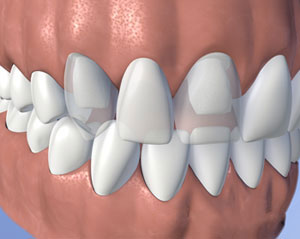
Fixed Bridge
A fixed bridge is a connected set of replacement teeth. For support, it is cemented into position on top of the teeth adjacent to the empty space. The protective outer layer of these teeth is usually removed or ground down prior to attaching the bridge.
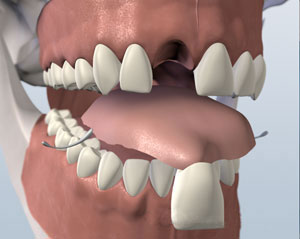
Flipper
A fragile, temporary and inexpensive solution is a removable plastic tooth with a plastic retainer, often called a “flipper”.
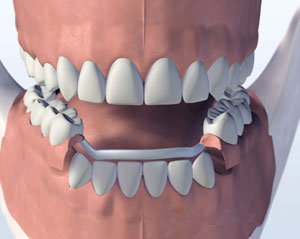
Metal Partial
A less fragile option is a removable partial denture cast in metal and plastic. It is held in place by wire clips. A removable partial denture can be removed and reinserted when required by the patient.
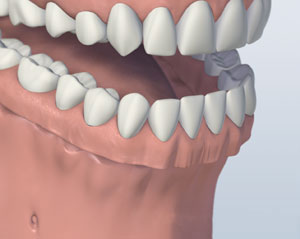
Denture
The most common solution, for people missing all teeth in one or both jaws are complete dentures. Some people adapt well to dentures. Others find them uncomfortable, even intolerable, because of differences in jaw size and shape.
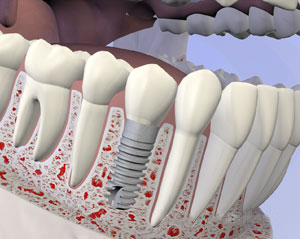
Dental Implants
Dental implants are the most comfortable and permanent solution. They form a strong foundation for teeth and keep the jaw healthy and strong. Implants support individual replacement teeth or secure specialized dentures in place. Unlike bridges, no healthy teeth are damaged. Unlike most bridges, implants can last a lifetime. Implant-supported replacement teeth can be attractive, stable, and comfortable for almost any patient.